
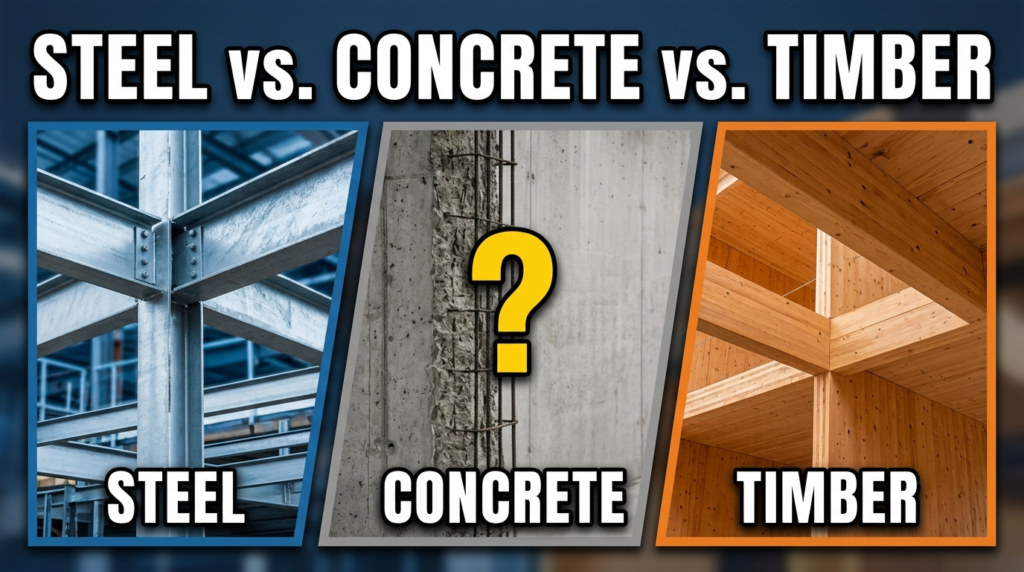
Choosing a structural system is one of the most consequential decisions you will make on any construction project. It shapes your budget, your build timeline, your long-term maintenance costs, and even the architectural possibilities open to you. Steel, concrete, and timber each bring distinct strengths and trade-offs, and the “best” material depends entirely on your project type, site conditions, climate, and goals.
This guide breaks down how the three systems compare across the factors that actually matter, so you can make an informed choice before construction begins, or before you hire an engineer to formalize the design.
Quick Comparison at a Glance
| Factor | Steel | Concrete | Timber |
|---|---|---|---|
| Strength-to-weight | Excellent | Moderate (heavy) | Good (lightweight) |
| Speed of construction | Fast | Slower (curing time) | Fast |
| Upfront material cost | High | Moderate | Low to moderate |
| Fire resistance | Needs protection | Excellent | Needs treatment/design |
| Sustainability | Recyclable | High carbon | Renewable, low carbon |
| Spans (long, column-free) | Best | Good | Limited |
| Maintenance | Corrosion control | Low | Moisture/pest control |
| Best for | High-rises, large spans, industrial | Foundations, durability, mass | Residential, mid-rise, eco builds |
Steel: Strength and Speed for Ambitious Spans
Steel offers the highest strength-to-weight ratio of the three materials, which is why it dominates high-rise towers, industrial warehouses, and any structure that needs long, column-free spans. Because steel components are typically prefabricated off-site and bolted or welded together on-site, projects move quickly and predictably.
Where steel excels:
- Tall buildings and structures with heavy loads
- Large open spaces such as warehouses, gyms, and event halls
- Projects where fast erection time reduces overall cost
- Designs requiring slender members and flexible future modifications
Trade-offs to consider:
Steel performs poorly in fire without protection, since it loses strength at high temperatures, so it usually requires fireproof coatings or encasement. It is also susceptible to corrosion in humid or coastal environments and needs proper detailing and protective treatment. Upfront material costs tend to be higher than timber, though speed of construction can offset this.
Concrete: Durability and Mass That Lasts Generations
Concrete is the workhorse of construction. Nearly every project, regardless of its primary structural material, relies on concrete for foundations. As a complete structural system, reinforced concrete delivers excellent durability, fire resistance, thermal mass, and acoustic performance.
Where concrete excels:
- Foundations and below-grade structures
- Buildings in fire-prone or high-humidity regions
- Projects prioritizing longevity and low maintenance
- Structures benefiting from thermal mass and sound insulation
Trade-offs to consider:
Concrete is heavy, which demands stronger foundations and can increase costs on poor soil. Cast-in-place concrete requires curing time, slowing the schedule. It also carries a high embodied carbon footprint, largely from cement production, which matters increasingly for sustainability-focused clients in the USA and Europe. Precast concrete can speed things up but adds transport and craning logistics.
Timber: Renewable, Warm, and Increasingly Modern
Timber has surged back into mainstream construction, driven by engineered wood products like cross-laminated timber (CLT) and glulam. These products allow timber to compete in mid-rise and even taller buildings that were once the exclusive territory of steel and concrete. Timber is lightweight, renewable, carbon-storing, and fast to assemble.
Where timber excels:
- Residential and low-to-mid-rise construction
- Sustainability-driven and low-carbon projects
- Sites with weaker soil, thanks to its light weight
- Designs valuing natural warmth and visible structure
Trade-offs to consider:
Timber is vulnerable to moisture, rot, and pests, so it requires careful detailing, treatment, and ventilation. Fire performance must be engineered through char-rate design and protective layers, though modern mass timber performs better than many assume. Long, column-free spans are harder to achieve than with steel. Building codes for tall timber are still evolving in some regions, which can affect approvals.
How to Choose: A Decision Framework
Rather than asking “which material is best,” ask these questions about your specific project:
- What are the loads and spans? Long, column-free spaces and very tall structures point toward steel. Standard residential layouts suit timber well.
- What is the climate and site condition? Coastal humidity challenges steel; weak soil favors lightweight timber; fire-prone areas reward concrete.
- What is the budget and timeline? Timber and steel build faster; concrete offers durability but needs curing time. Material cost is only one part of total cost.
- What are the sustainability goals? Timber stores carbon and is renewable; concrete carries higher embodied carbon; steel is highly recyclable.
- What does local code allow? Regulations differ between US states and European countries, especially for tall timber and seismic zones.
Often the right answer is a hybrid system: a concrete foundation and core, steel for long spans, and timber for upper floors or finishes. Many of the most efficient modern buildings combine all three.
Getting the Design Right Matters Most
No material choice succeeds without sound engineering behind it. The same span, load, and connection can be safe and economical or over-built and costly depending on how it is designed and detailed. Mistakes here are expensive to fix later and can compromise safety.
If you are weighing these options for a real project, professional structural analysis and clear, code-compliant drawings turn a good material choice into a buildable one. I help clients worldwide with structural design, calculations, detailing, and 3D structural modeling, as well as interior and exterior design and photorealistic rendering to visualize the result before a single beam is placed.
Ready to move forward? If you need structural design, drawings, or a second opinion on your build, you can [hire me on Fiverr or Upwork], or message me directly through [558consultants.com] to discuss your project. Let’s make sure your structure is safe, efficient, and built right the first time.
Frequently asked questions:
Which is cheapest: steel, concrete, or timber? Timber usually has the lowest upfront material cost for residential scale, but total cost depends on span, labor, foundations, and finishes. Steel can be cost-competitive on large or fast-track projects.
Which material is most fire-resistant? Concrete is inherently the most fire-resistant. Steel and timber can both be designed to meet fire codes through protection and detailing.
Can I mix structural materials? Yes. Hybrid structures combining concrete foundations, steel spans, and timber elements are common and often the most efficient solution.
